Visualizzazione post con etichetta Arba sicula. Mostra tutti i post

sabato 14 giugno 2025

TESTA DI TURCU E BASILICÒ. Eseguita dal Val D'Akragas per gli italoameri...


Agrigento, giovedì 12 giugno 2025. In occasione del tour annuale in Sicilia dell'Associazione di italoamericani ARBA SICULA, presieduta dal prof. Gaetano Cipolla, il Gruppo Folk VAL D'AKRAGAS, guidato da Lello Casesa, ha inserito nel suo spettacolo d'accoglienza anche la canzone TESTA DI TURCU E BASILICÒ. In estemporanea, ha partecipato per l'occasione l'Autore.

Il testo completo della canzone

Ritornello:

Ti dissi "resta" e tu dicisti "no"

Testa di Turcu e basilicò.

Basilicò ci misi a la finestra

nni la tò crozza comu fussi grasta.

Ti dissi "resta" e tu dicisti "no"

Ti dissi "resta" e tu dicisti "no"

Dicisti "no no no".

Pirchì dicisti "no"?

I

Pi l’Africa vulivatu scappari,

La Kalsa di Palermu abbannunari. 

P'amuri, Amuri, iu persi la testa.

Pinzannu a chiddra mi dicisti “Basta”. 


Amata, iu t’amà - vu e fummu amanti: 

La mmidia li sbampà - va a tanti e tanti.

Tu mi vulisti e iù - ti dissi "sì".

Abbannunari a mia - pirchì, pirchì?

II

L’amuri tò fu farsu, di facciata,

Rigina mi cridiva e no criata.

Na grasta mi ristà e  iu mischina 

Di lacrimi l'assuppu ogni matina.


Testa di Turcu, tù, di terracotta, 

Di terracotta a mìa m’ann’a fari. 

Allatu a tia, Amùri, anchi si morta,

Testa cu testa nn’àmm’a taliari. 

III

Di terracotta è fatta a Munriali.

A Burgiu è virdi, di cilesti mari.

A Scicli e Castelbuonu, ddrà si mancia. 

L’artista la fa bella e la stracancia.


La fannu a Santu Stefanu giganti.

A Sciacca luci comu gran brillanti!

Caltagiruni, lu primatu è tò.

Ognunu l’avi n càpu lu comò.


sabato 27 giugno 2020

CHARLES GIORDANO RECENSISCE "THE POET SINGS FOR ALL / LU PUETA CANTA PI TUTTI". Su "L'anello che non tiene"

Ringrazio Gaetano Cipolla, editore, traduttore, autore dell'introduzione e curatore di  The Poet Sings For All / Lu pueta canta pi tutti, nell'annunciarmi che la recensione di Charles Giordano al mio libro di poesie coincide con la ripresa della pubblicazione della rivista  "L'anello che non tiene" Journal of Modern Italian Literature


https://anello.frit.wisc.edu


Charles B. Giordano

Strayer University

Piero Carbone. The Poet Sings For All / Lu pueta canta pi tutti. Translated by Gaetano Cipolla. Mineola, NY: Legas Publishing, 2014. Pp.89.
         
Piero Carbone’s The Poet Sings For All / Lu pueta canta pi tutti is the latest in the series of Pueti d’Arba Sicula, published by the Arba Sicula Press (Legas) and edited by Gaetano Cipolla. The collected poems by earlier and contemporary writers have as a major goal the transmission of Sicilian art and culture by providing dual texts in Sicilian and English side by side, and sometimes providing trilingual texts when Italian is included.

Born in Racalmuto, Sicily, in 1958, Piero Carbone spoke Sicilian in his youth but was then forced to speak Italian so that he would have a chance for a better career in life.  The writer and I have much in common.  Born to Sicilian immigrants in Connecticut, I spoke only Sicilian until I went to school.  
It was necessary to learn English well so that I also could have a chance at a good career.  Both Piero and I learned to express ourselves well in our “foreign language” so that we even became teachers of that imposed language. Piero Carbone, however, retained his native language so beautifully that he now not only writes poetry in Italian but also in Sicilian.  
One thing is certain; he has not lost his Sicilian soul.  Carbone expresses his Sicilian soul in poems such as “They’re the Same Fragrant Roses.”  He speaks of his father’s lifetime of hard work in the wheat fields and orchards but at the end of his life how he loved the roses he had planted.  While life in Sicily was harsh, there were the good things in life which made living worthwhile. 

Piero’s heritage is not that of his father’s sweat and tears; it is the beauty of life, which Piero has transplanted into his own garden. Heritage is carried on by the tangible roses but there is something indefinable in these roses; the fragrance of sweet memories. Similar in tone is Carbone’s “Bless the One Who Planted Them.” The olive trees planted by Piero’s father are a symbol for heritage. The long-living olive trees will provide not only physical and spiritual sustenance to Piero but also to the many generations that will come after him.

Although, in general, life in Sicily has improved in some ways since Carbone’s youth, there may be too many good things of the past that have been lost. In his poem “Always Burning Hot,” Carbone remembers having baked his bread in his own oven. 
Now that he buys bread from a bakery, he cannot stop thinking of his outdoor oven, which he had destroyed. There is something that he cannot pinpoint, but there is a personal, emotional draw to that lost, meaningful activity. It had been an integral part of his life as it had been for many generations. However, the nostalgic remembrance of having baked his own bread made from the wheat fields of Sicily becomes a bitter lament in Carbone’s “And We Eat Poisoned Bread.” 

While the Sicilian countryside still overflows with wheat, the peasant farmers are gone, replaced by polluting machines. 
What is even worse is that some wheat is imported from distant lands. Such wheat lacks the purity of Sicilian heritage. Worst of all, some Sicilian wheat is exported to foreign countries to be processed and then exported back to be made into cheaper flour to make genuine “Italian” pasta or other “home grown” wheat products.  It is no wonder that Carbone believes it is contaminated. To the Sicilian such bread and pasta is not life-nourishing but poisonous in many ways.

At times in his poetry, Piero Carbone exhibits a simple, fatalistic acceptance of reality. This theme is stated quite simply and matter of factly in his poem “I Went On Foot.” 
A person waits in vain for the seven o’clock train, but instead of showing any frustration, he optimistically waits for the eight o’clock train, which does not come either. After patiently waiting the whole day without the train having come, he realizes that there is nothing he can do about it and goes on foot. 
In another poem, “It Sounded Like a Song,” Brother Felici sits on the steps of the church every night thinking the same simple thoughts about his life and looking up toward the setting sun. 
When asked by another Brother what he is doing, Brother Felici simply answers that he is waiting for death. 

The comment at the end of the poem reveals that Brother Felici (“Happy”) is living up to his name. He has been content with his life and looks happily to his death. While both the man waiting for the train and Brother Felici accept life passively as it is, the prisoner, entombed in a cell without any light for thirty years in Carbone’s “Light Kills,” incessantly digs through a wall four meters thick with a little spoon as a tool. 

He digs obsessively to be able to see again that light of which he has been deprived. Finally, in a Kafkaesque moment, he breaks through to be overcome by the brilliant flash and dies. The final two verses, “Darkness is death. Light kills,” is an enigma. 
While the prisoner longed to see light which for him was equal to being alive, finally seeing light after such a long, harsh struggle ends in death. But what kind of death?  Is it death to his living death, having been entombed in darkness, or is it entrance into eternal light? Light has killed darkness, which is what he had longed for – release from his living death.

Considering nature and the artist as creators of beauty, Carbone in his poem “Now She Is All Blond” portrays nature as a natural artist actively creating beauty in the forms that it shapes and colors. While nature tenderly caresses and lovingly creates an original work of beauty objectively from the four elements, the human artist paints his pictures subjectively, causing the end product to appear as he wants it to appear. 

The original painter of the Black Madonna may indeed have painted the Madonna as he saw her but having done so even subjectively, she is his original creation. As for the “restorer” who lightened her flesh, he achieved nothing. Carbone still sees the Madonna as a miraculous work of art whether she is painted black or white. Carbone does not see the change in color as a distortion or an improvement. The color is superficial. To his credit, Carbone goes beyond color to appreciate the unique artistry in the painting.

As a postscript to his The Poet Sings for All/Lu pueta canta pi tutti, the Sicilian poet Piero Carbone explains that although as a young man he was forced to use Italian in order to socially succeed, he never rejected his mother tongue. At the age of fourteen he wrote his first poem, and as it was in Sicilian. Communicating, writing and teaching languages gives stability and warmth to life for Carbone.

                                                              
Contatti:
Legas Publishing


mercoledì 10 giugno 2020

GRAZIE, JOE. L'amicizia che procede è una bella poesia


Grazie a Joe Baiardo,  per aver condiviso su fb la copertina del mio libro con un lusinghiero commento: un gesto di grande stima che mi onora grandemente (e mi carica di responsabilità).


Anticipo,
 in suo onore e dei tanti canadesi che hanno a cuore la Sicilia
 e il suo cuore che è il dialetto,
 una poesia della prossima raccolta, 
pensando al carretto artistico che hanno voluto esporre ad Hamilton
 in un luogo prestigioso, presso LIUNA Station.

Il carretto e il carrettiere, 
una figura simbolica che prefigura la vita in cammino, 
nella placida notte come nel chiaro giorno,
un cammino che ci si augura sempre gradevole e proficuo. 


fannu ancora maraviglia


Lustru di luna, va lu carrittieri
Lustru di luna c’è e va cantannu
Lustru di luna, va pi li trazzeri
Comu la vita, un torna mai darrieri.

Scrusciu di rota e scrusciu di catina
Scrusciu di notti e scrusciu d’ammatina
Scrusciu ch’è mutu,  scrusciu nun ci nn’era
Si c’era azziddru di cori e di pinzera.

Lu cavaddru ccu la zzotta
Si durmiva s’addriviglia
Un carrettu e un carrittieri
Fannu ancora maraviglia

Realizzato con il contributo artistico di Dino Agrò


Chiaro di luna, va il carrettiere
Chiaro di luna c’è, e va cantando
Chiaro di  luna, va per le trazzere
Come la vita, non torna mai indietro

Fragore di ruote, fragore di catena
Fragore di notte, fragore di mattina
Fragore ch’è muto, fragore non c’era
Se c’era cruccio di cuore o di pensieri.

Il cavallo con la frusta
Se dormiva, poi era sveglio
Un carretto e un carrettiere
Fanno ancora meraviglia.

Piero Carbone


mercoledì 28 febbraio 2018

"DECI, CIENTU CITALENI" SU "SICILIA PARRA". Ten, One Hundred Miner's Lamps

Un ringraziamento al prof. Gaetano Cipolla 
per la pubblicazione e traduzione in inglese e in siciliano
 di alcune poesie scritte originariamente in siciliano o in inglese,
tra cui il mio testo, musicato da Domenico Mannella,
 "Deci, cientu citaleni".

Autori degli altri testi tradotti:
Peter Schutt
Renato Fiorito
Fefè Vaccaro
Nino Provenzano
Anna Maria Bonfiglio
Giovanni Meli
Joe Amato


La canzone su you tube:
*
*


giovedì 21 dicembre 2017

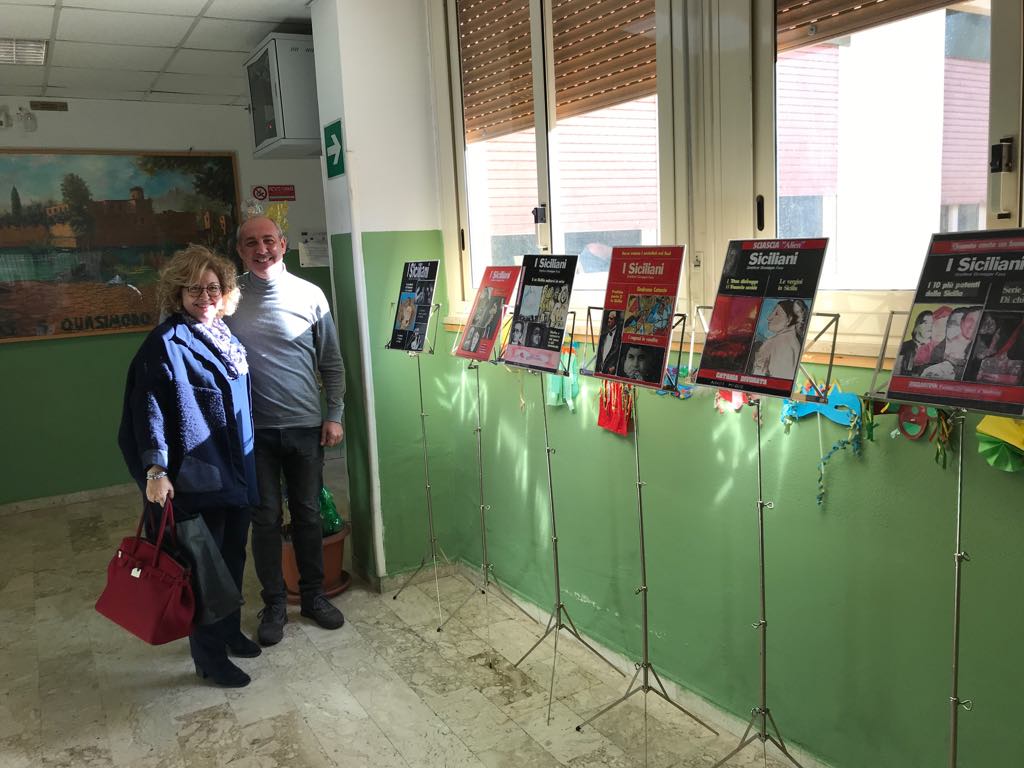
"I SICILIANI" AL "MAREDOLCE" DI PALERMO. Proposta di una mostra itinerante, e non solo

I SICILIANI IN... SICILIA
Idea per una mostra itinerante
a cura dei proff. Piero Carbone e Maria Rosaria Lo Porchio

Dietro quelle copertine c'è un mondo

Riproduzione  copertine de "I Siciliani" su pannelli telati, 
eseguita con tecnica mista (acrilici e collage) formato 30x40cm

Il dirigente dell'Ics "Maredolce" di Palermo Vito Pecoraro

Il Dirigente scolastico con la professoressa Maria Rosaria Lo Porchio
 che ha guidato i ragazzi nella riprososizione pittorica delle copertine


Riscontri su fb

Francesco Virga Grazie Piero!

Mi piaceVedi altre reazioni
Rispondi
1
19 dicembre alle ore 12:53
Gestire
Riccardo Orioles Grazie ragazzi!

Mi piaceVedi altre reazioni
Rispondi
1
19 dicembre alle ore 13:02
Gestire
Piero Carbone da Racalmuto Grazie a te per la preziosa collaborazione
Gestire
Fabio Giallombardo guardate che meraviglia, Pii FratelliFrancescaAndreozzi, ClaudiaAndreozzi, AlessandraAndreozzi e Cristina Fava

Mi piaceVedi altre reazioni
Rispondi
1
19 dicembre alle ore 13:35
Gestire
Piero Carbone da Racalmuto caro Fabio sarebbe bello se potessi esserci alla manifestazione di gennaio al Palaoreto per la presentazione ufficiale, tu sei in qualche modo coautore di questa idea maturata in occasione della presentazione del tuo libro a Racalmuto lo scorso settembre e sposata come ne ero sicuro con entusiasmo dalla mia scuola
Gestire
Fabio Giallombardo pietro, sarebbe un onore per me esserci, ma purtroppo per natale quest'anno rimarrò nelle Marche. A marzo però sarò in Sicilia per 10 giorni dinoresentazioni! potrei passare a trovare znche voi, se ci orgsnizziamo! 
Gestire
Piero Carbone da Racalmuto dimmi il periodo, ti metto in contatto con il collega che si occupa degli incontri con l'autore
Gestire
Fabio Giallombardo 15-25 marzo. Parto da Palerno e chiudo con Palazzolo (passando per Morreale, Terrasini, Agrigento, Ribera, Gela, Catania, Siracusa
Gestire
Piero Carbone da Racalmuto dò il tuo numero al referente
Gestire
Piero Carbone da Racalmuto e se portassi in tour con te le copertine realizzate dai nostri ragazzi?
Gestire
Lucrezia Salemi grazie

Mi piaceVedi altre reazioni
Rispondi19 dicembre alle ore 18:13
.

Il prof. Gaetano Cipolla, già docente alla St. John's University di New York nonché attuale direttore della rivista bilingue "Arba Sicula/Sicilia Dawn", che ha portato avanti varie iniziative con alcune scuole siciliane e in particolare con l'Istituto Maredolce di Palermo, ci fa sapere di avere tradotto in inglese, qualche anno fa,  l'opera teatrale di Giuseppe Fava "La violenza".

"Qualcuno a New York  - scrive il prof. Cipolla - mi chiese di tradurre sperando di poterla poi presentare off-Broadway. Non se ne fece nulla anche se io sono riuscito a far rappresentare brani dell’opera teatrale ad un convegno di Italianisti a New York. Comunque, avendo fatto lo sforzo di tradurre l’opera, ho voluto anche pubblicarla."

Il professore Cipolla, benemerito per la promozione e divulgazione della cultura siciliana in America, lamenta la poca, pochissima attenzione verso quella operazione culturale anche da questa parte dell'Oceano.

Ora, l'occasione della riproposizione delle copertine della rivista diretta inizialmente da Giuseppe Fava, ucciso il 5 gennaio 1984 per il coraggio delle sue denunce, ci sembra una buona occasione per ricordare chi si è prodigato nel promuovere il pensiero e l'opera del giornalista, scrittore e drammaturgo catanese con una significativa e generosa iniziativa editoriale.
E magari riproporre quella traduzione sostenendola con più determinazione da parte di coloro che apprezzano o dicono di apprezzare la figura di Giuseppe Fava, la sua scrittura, il suo operato.


ph ©archivioepensamentiblog